How can my child learn the times tables fast?
Shrink the list first, then practise ten minutes a day. Because 7×6 and 6×7 are the same fact, the 1–10 grid is 55 pairs, not 100. Treat the 1s, 10s, 2s and 5s as rules and 21 pairs are left. After the 9s and the squares, only ten facts need real work. Teach the tables in the order 2, 10, 5, 4, 3, 9, 6, 8, 7.
Why does more drilling not work?
Because most of that time is spent on facts your child already owns. Drilling the whole grid at random is what most children are handed, and three things go wrong with it.
It treats the grid as a hundred unrelated items, when most of it is a handful of patterns. It hides which facts are actually weak, so the easy ones come round again and again while the five or six that cost real time never get pulled out on their own. And long sessions build dread. Twenty minutes of flashcards on a school night teaches a child that multiplication is a punishment.
The fix is the opposite of more. Shrink the list. Teach it in an order where each table leans on the one before. Then ten minutes a day, and stop.
How many facts does my child really have to learn?
Ten. Written out, the 1–10 grid looks like 100 facts, which is why it frightens everybody at the kitchen table. Take it apart and nearly all of it turns out to be rules.
- Order does not matter. 7×6 and 6×7 are the same fact learned once. Counting each pair once turns 100 written facts into 55 pairs.
- The 1s are a rule, not facts. Drop every pair containing 1 and 45 are left.
- The 10s are place value. Write the number, add a zero. Drop every pair containing 10: 36 left.
- The 2s are doubles, which most children own before they ever meet multiplication. Drop them: 28 left.
- The 5s are half of the 10s, or the clock face. Drop them: 21 left.
Twenty-one pairs remain, and every one of them is built from 3, 4, 6, 7, 8 and 9. Teach the 9s pattern in the table below and the six pairs containing a 9 go too, leaving 15. Teach the five squares — 3×3=9, 4×4=16, 6×6=36, 7×7=49, 8×8=64 — as their own small set, and ten facts are left:
3×4=12 · 3×6=18 · 3×7=21 · 3×8=24 · 4×6=24 · 4×7=28 · 4×8=32 · 6×7=42 · 6×8=48 · 7×8=56
That is the whole difficulty, and it clusters around 6, 7 and 8. Ten facts fit on a sticky note on the fridge. A hundred do not. Everything else is a rule or a pattern, so teach it as one — a child who memorises 5×8 instead of halving 80 is carrying weight nobody needed to pick up.
Play free in your browser
Times Tables
Grade 3+
The order to learn the tables in
Work down this list in order. Each table is built out of one your child already has, so nothing arrives cold.
- 2s — doubling. Most children arrive with this.
- 10s — add a zero. 10×7 = 70.
- 5s — half of the 10s. 5×7 is half of 70, so 35.
- 4s — double the 2s, which is doubling twice. 4×7: 7 → 14 → 28.
- 3s — double, then add one more group. 3×7 = 14 + 7 = 21.
- 9s — ten groups minus one group. 9×7 = 70 − 7 = 63.
- 6s — the 5s plus one more group. 6×7 = 35 + 7 = 42.
- 8s — double the 4s, which is doubling three times. 8×6: 6 → 12 → 24 → 48.
- 7s — by this point the only new fact in the 7s is 7×7 = 49.
Look at what happened to the 7s, the table every family dreads. Taken last, it is nearly empty: 7×2, 7×3, 7×4, 7×5, 7×6, 7×8, 7×9 and 7×10 were all covered by earlier tables. The 7s are only hard when they come first.
What does a ten-minute routine look like?
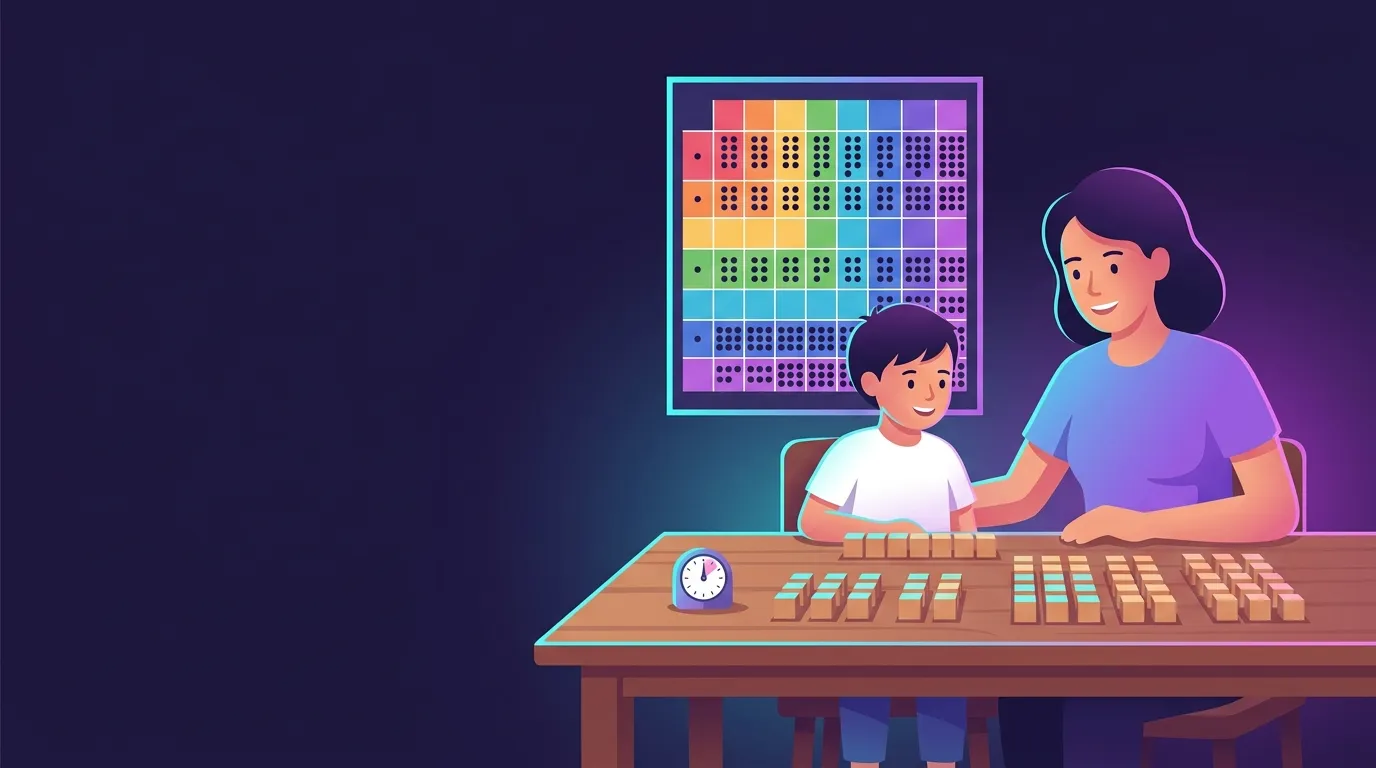
Four short blocks, the same four every day, in this order. Ten minutes before dinner is plenty. Set a timer and obey it: when it goes, stop, even if it was going well — stopping while it still feels easy is what makes your child willing to sit down again tomorrow.
- Minutes 1–2, warm-up. Say this week's table out loud, forwards, then backwards. The only chanting in the routine: it makes the numbers familiar, it does not build recall.
- Minutes 3–5, the weak five. Five facts on cards, the same five all week, the ones that came out slow yesterday. Say the answer, turn the card, move on. No scoring.
- Minutes 6–8, mixed recall. Facts out of order, from every table learned so far. This is the block that actually builds fluency, and the one everybody skips. A short round on a times tables practice game does it without anyone having to hold cards.
- Minutes 9–10, backwards. Ask "six times what is 42?" instead of "what is 6×7?". Missing-factor questions are division in disguise, and the fastest way to catch a half-learned fact — try a round of missing factor practice here.
Once a week, swap the mixed-recall block for paper. A multiplication worksheet for 3rd graders comes with an answer key, and it leaves you what a screen does not: a written record of which facts are still slow.
Free printable worksheet
Multiplication — 3rd Graders
Worksheet · PDF
One trick per table
None of these are party tricks. Each is a real pattern in the numbers, and a child who sees it needs far fewer repetitions to keep the fact.
| Table | Trick | Worked example |
|---|
| 2s | Double it | 2×8: double 8 → 16 |
| 4s | Double twice | 4×7: 7 → 14 → 28 |
| 8s | Double three times | 8×6: 6 → 12 → 24 → 48 |
| 5s | Half of the 10s | 5×7: half of 70 → 35 |
| 9s | Ten groups minus one group | 9×7: 70 − 7 = 63 |
| 9s check | The two digits always add to 9 | 63: 6 + 3 = 9 |
| 3s | Double, then add one more group | 3×7: 14 + 7 = 21 |
| 6s | The 5s plus one more group | 6×7: 35 + 7 = 42 |
| Squares | Learn 6×6=36, 7×7=49, 8×8=64, 9×9=81 by sight | No working needed |
| Next to a square | Take the square, add the smaller number | 7×8: 49 + 7 = 56 |
| 7×8 | The digits run 5, 6, 7, 8 | 56 = 7×8 |
The 9s are worth a minute on their own. From 9×1 to 9×10 the tens digit is always one less than the number you multiplied by, and the two digits always add to 9. So 9×7 starts with 6, and 6 plus 3 is 9: 63.
The "next to a square" rule rescues the worst pair in the grid. If 7×7 = 49 is solid, then 7×8 is 49 + 7 = 56, and 6×7 is 36 + 6 = 42 — two of the ten hard facts out of one square. More shortcuts of that shape are in mental math tricks that work.
How do I tell recall from fast counting?
Listen for what happens before the answer. Recall arrives whole, in about three seconds, with nothing visible in between; counting shows up as a delay, a whisper or a finger.
Speed alone is not the test. A child who counts up in sixes very fast is still counting, and counting collapses as soon as a second step is added. Four signs that a fact is being counted:
- The answer takes noticeably longer for bigger numbers in the same table.
- Your child recites the table under their breath before answering.
- Fingers, taps or eye movements appear.
- 6×7 comes out fine but 7×6 needs a restart. A recalled fact works in either order.
England's statutory multiplication tables check gives Year 4 pupils 6 seconds to answer each of 25 questions, according to the Department for Education administration guidance. Six seconds is generous for recall and tight for counting, which is the point of the limit.
Test in mixed order, never down a table, and include the reverse direction. Asking whether 48 is a multiple of 6, or of 8, checks the same knowledge from a third angle — a round of multiples practice is a quick way to do it.
The four-week plan
Four weeks at ten minutes a day comes to about 5 hours of practice. That is a realistic budget for the 1–10 grid, as long as the order above is kept.
| Week | New this week | Daily focus | End-of-week check |
|---|
| 1 | 2s, 10s, 5s | Doubling and halving warm-up, then mixed recall of 2, 5 and 10 | 20 mixed facts, each inside 3 seconds |
| 2 | 4s, 3s | Double-twice for the 4s, double-plus-one-group for the 3s | 20 facts from 2, 3, 4, 5 and 10, including reverses |
| 3 | 9s, 6s | The 9s digit pattern, then the 6s as the 5s plus one group | 25 mixed facts, plus 5 missing-factor questions |
| 4 | 8s, 7s, squares | Only the ten hard facts, plus one square a day | 25 mixed facts from the whole grid, no counting |
If a week's check is not clean, run that week again rather than pushing on. A shaky 4s table makes the 8s twice as hard, because the 8s are built on them.
When the 1–10 grid is fluent, the 11s and 12s take a few days more. For 11×1 to 11×9 the digit simply doubles: 11×7 = 77. For the 12s, split into a 10 and a 2: 12×7 = 70 + 14 = 84. Both are rules, not new memory work. If you would rather a screen ran the mixed-recall block, the multiplication tables game and the times tables drill both open without a sign-up.
Practise it in the MathIt app
About 90 math games with adaptive difficulty, daily practice and 2–5 player battles — free on iOS and Android.