What are the signs of dyscalculia in children?
Dyscalculia is a specific learning difficulty with numbers. Common signs are trouble comparing quantities, counting on fingers long after classmates stop, forgetting number facts that were practised yesterday, and losing track of place value. One sign alone means little. A pattern that persists for months, across teachers and topics, is the reason to ask the school for an assessment.
What dyscalculia is — and what it is not
Dyscalculia is a specific learning difficulty with numbers. Understood describes it as a learning disorder that makes it hard to understand maths concepts and work with numbers, affecting even the most basic skills, such as knowing bigger from smaller or estimating an amount. The Cleveland Clinic frames it the same way: it affects the ability to do maths and to understand number-based information, roughly as dyslexia affects reading.
This article is general information for parents. It is not a diagnosis, and MathIt is a games company, not a clinic. Only a qualified assessor can say whether a child has dyscalculia.
It is not a measure of intelligence. It is not laziness. It is not the result of one bad school year. Nor is it the same as simply being behind. The British Dyslexia Association points out that a specific learning difficulty in maths is more common than dyscalculia itself — many children who struggle with numbers have a processing difficulty, a gap in teaching, or both, rather than dyscalculia.
How common is it? The Cleveland Clinic writes that experts estimate it affects between 3% and 7% of people worldwide, and Understood gives a figure of up to 7 percent. Both ranges make it roughly as common as dyslexia: one or two children in a class of thirty.
Signs of dyscalculia by age
One sign on its own means nothing. What counts is a pattern — several signs, in the same child, that stay put for months while classmates move on. The table groups the signs those sources list by the age at which parents notice them.
| Age | What you might notice |
|---|
| Preschool (3–5) | Trouble learning to count in order; no link between the word "four" and four objects; difficulty sorting by size or shape; ordering things smallest to largest does not click |
| Early primary (5–8) | Still counting on fingers long after classmates stop; cannot see four dots as four without counting them; mixes up the + and − symbols; number symbols read as shapes rather than amounts |
| Later primary (8–11) | Multiplication facts will not stick however often they are practised; word problems are guessed at; place value collapses (204 written as 2004); analogue clocks and money stay hard |
| Secondary and adult | Counting backwards is slow; multi-step problems fall apart halfway; measuring, cooking quantities, estimating distance and handling money stay effortful |
Two details carry more weight than the rest. The first is quantity sense. The Dyscalculia Network, citing the SASC 2025 definition, centres dyscalculia on a pronounced and persistent difficulty with numerical magnitude — naming, ordering and comparing quantities, estimating, and place value. A child who cannot say which of two small piles of raisins is bigger without counting both is showing exactly that. The second is the forgetting: facts learned on Monday are gone by Wednesday, even though Monday's effort was real.
Our guide to what maths each grade should know sets out what is usually expected, year by year.
Dyscalculia, maths anxiety, or a gap?
Three very different things produce the same sentence — "my child cannot do maths" — and each needs a different answer.
- A gap in teaching. Your child missed the lessons where place value or regrouping was built, through illness, a house move, or a rushed term. The tell: everything that does not depend on the missing idea is fine, and the missing idea is picked up quickly once it is retaught.
- Maths anxiety. Your child can do the maths at the kitchen table and freezes at the board or in a test. The tell: performance depends on the audience and the clock, not on the topic. The Dyscalculia Network is explicit that maths anxiety commonly co-occurs with a specific learning difficulty in maths but is not an indicator of one in itself.
- Dyscalculia. The difficulty sits in the quantities themselves, it shows across topics and across teachers, and it persists after good teaching has been tried.
The three overlap. A child with dyscalculia often develops anxiety about maths, and anxiety widens a gap. That is one reason a parent cannot settle the question alone.
How is it assessed, and who do I ask?
You cannot diagnose dyscalculia at home, and neither can an app. What exists is a structured assessment of skills, carried out by a qualified professional, that also rules other causes out. There is no blood test and no scan — the Cleveland Clinic states plainly that no lab, imaging or diagnostic test confirms dyscalculia.
Who does it depends on where you live:
- Start with the school. The class teacher first, then the special educational needs coordinator or the local equivalent. The school sees your child every day and holds the attainment record.
- Ask for a formal evaluation. In the United States, Understood notes that public schools evaluate children free of charge, using standardised instruments such as the Woodcock-Johnson, the WIAT and WISC-V subtests.
- An educational psychologist or specialist assessor. The Dyscalculia Network lists educational psychologists and Level 7 specialist assessors holding SASC-approved qualifications as the people who can complete a diagnostic assessment in England, and says such an assessment runs three to five hours, sometimes split across sessions.
- Adults who were never assessed as children usually go privately; Understood names psychologists, psychiatrists and neuropsychologists.
Before that first meeting, write down what you have seen: dated examples, the actual worksheets, the words your child uses about numbers. Evidence moves a referral faster than a worry does.
What helps at home?
Touchable amounts, a visible number line, short sessions with no clock and no audience. None of it replaces an assessment, or the specialist teaching that may follow — but it keeps number sense growing, and keeps your child willing to try.
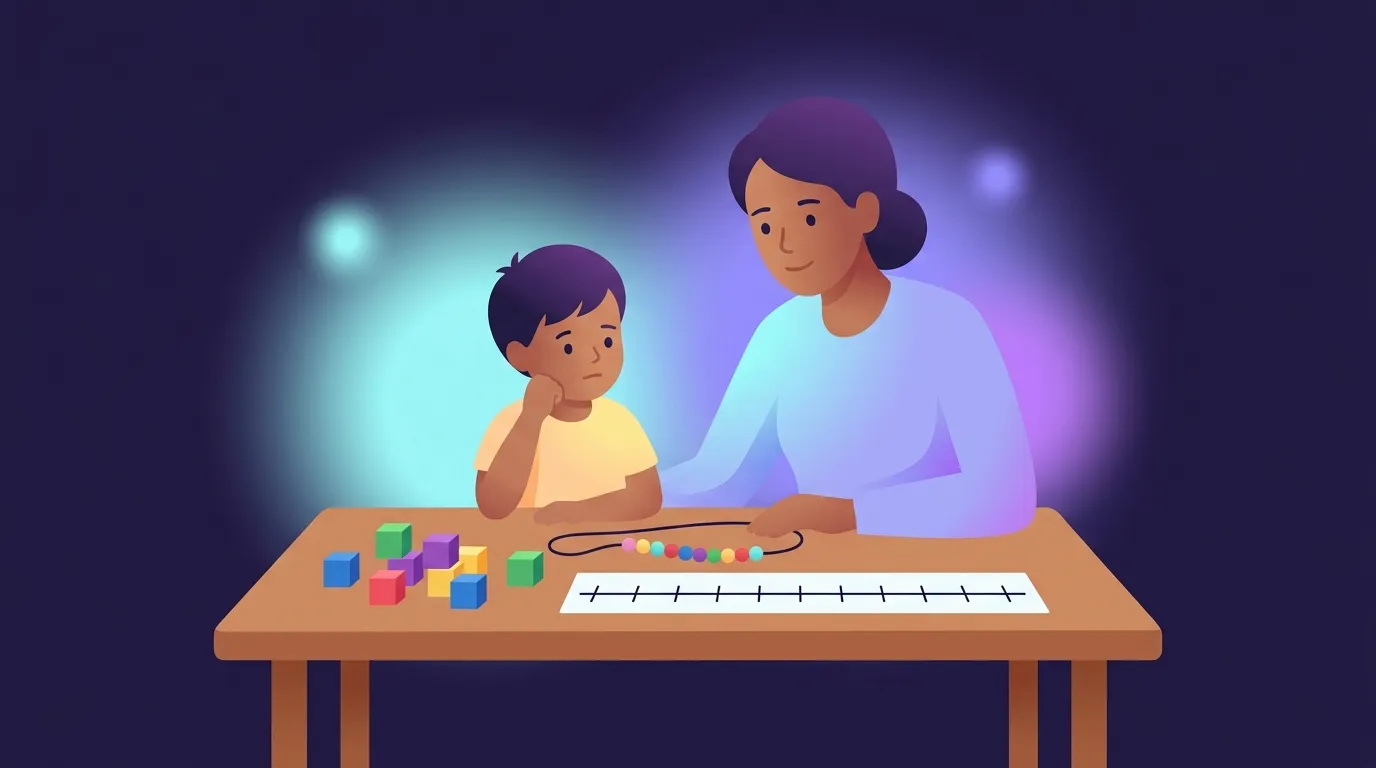
- Put the maths in their hands. Buttons, pasta, coins, bricks. If a number does not mean an amount yet, the amount has to be touchable. Count them, split them, compare two piles.
- Use a number line, visibly. A strip on the wall or taped to the table turns "what is 13 − 5" into a walk along a line rather than a memory search.
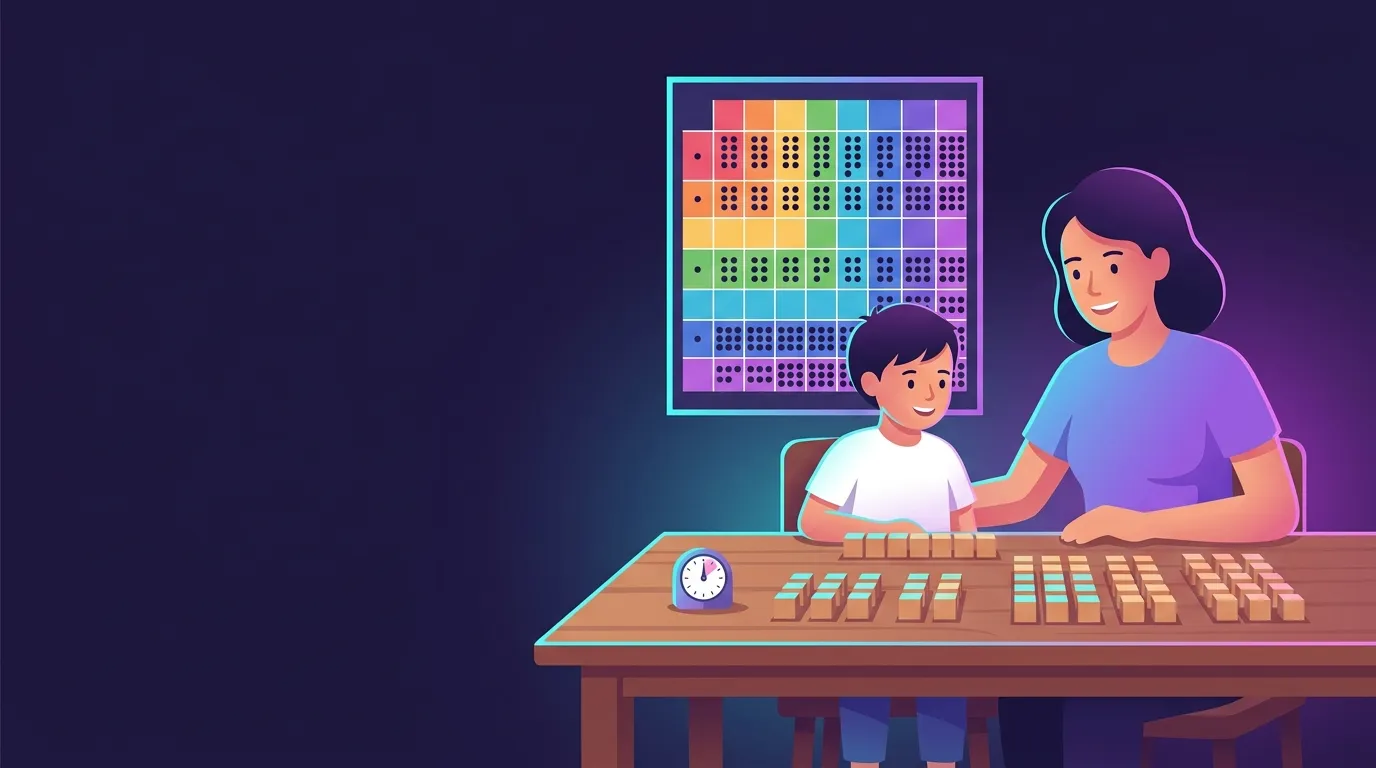
- Keep sessions short and untimed. Five to ten focused minutes beats a tearful hour. Speed is the last thing to work on, never the first.
- Never make it public. No quizzing in front of siblings, no races at the dinner table, no "you should know this by now".
- Say the quantity out loud. "Three biscuits, and two more — look, five." Narration ties the word, the symbol and the amount together.
- Repeat one small thing. Comparing two quantities, then pairs that make ten, then pairs that make twenty. Breadth is not the goal here.
Play free in your browser
Counting Objects
Pre-K–K
Two skills deserve more practice than anything else at this stage: seeing which quantity is larger, and knowing the pairs that make ten. Our free comparing-numbers game does the first with pictures instead of digits, and counting objects keeps the amount on screen while the number is named. For pencil-and-paper work at the same level, the addition worksheet for 1st graders prints with an answer key.
Practice that does not punish slowness
An app does not treat dyscalculia. No game cures it, and any product that claims otherwise is selling you something. A practice tool has a smaller, honest job: repetition of the basic number skills, without the two things that make a struggling child stop — a clock and an audience.
Three rules for choosing practice, whatever tool you use:
- It must be untimed, or the timer must be switchable off. A child who needs eight seconds is still doing the maths.
- It must show quantities, not only digits. Objects, dots, bars. Bare digits are precisely the part that is not working.
- It must adapt downwards, not only upwards. If ten questions in a row go wrong, the level has to drop without your child having to ask for it.
MathIt is free on iOS and Android, has about 90 game types, and 22 of them play in the browser with no sign-up, so you can try a skill before installing anything. Difficulty adapts to the answers given, and the browser games under maths games for kids are the gentlest start. Number bonds are the highest-value thing to drill, because every later addition and subtraction strategy rests on them.
Play free in your browser
Number Bonds
Grade 1–2
When your child plays the number bonds game, watch how they answer rather than what they score. Counting up from one every time, instead of recalling the pair, is the observation worth carrying into the school meeting.
When should I talk to the school?
Raise it when a pattern has lasted a school term — or sooner, if your child is distressed. Specifically, ask for a conversation if:
- Signs from several rows of the table above are present and have not shifted in a term.
- The gap between your child's maths and their reading, speech or general reasoning keeps widening.
- Homework regularly ends in tears, avoidance or stomach aches.
- Extra practice at home has produced no durable change over a few months.
Ask three questions at that meeting. What does the school's own assessment data show? What support can start now, without a diagnosis? And what is the route to a formal assessment here? The label matters less than the timing: the Cleveland Clinic notes that earlier intervention produces better outcomes, and support can begin long before an assessment date is booked.
Practise it in the MathIt app
About 90 math games with adaptive difficulty, daily practice and 2–5 player battles — free on iOS and Android.