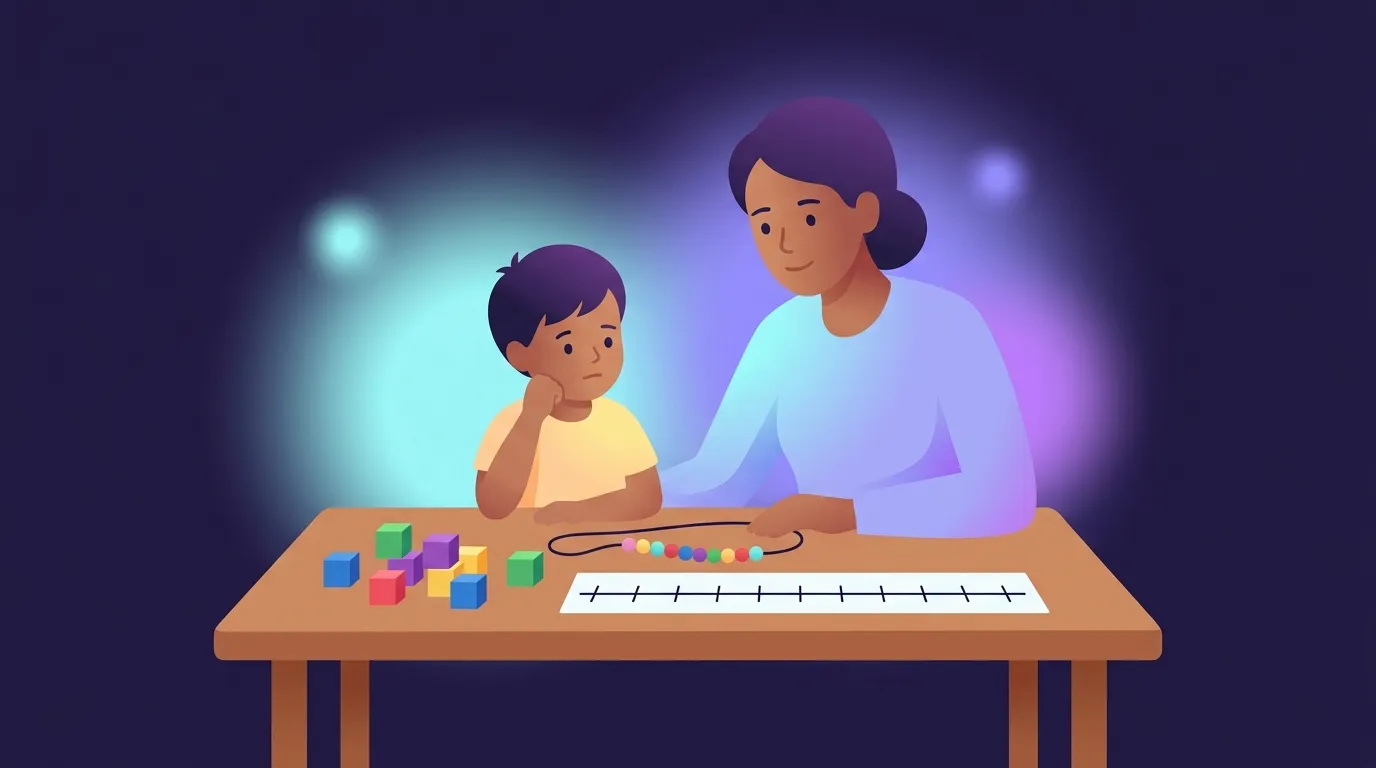
Why do adults stall at math?
Because of three or four specific holes, not a general weakness. Usually the 6, 7, 8 and 9 times tables, division and fractions — facts that never became automatic at school — with everything built on them wobbling since.
Arithmetic is a memory problem before it is a thinking problem. When 7 × 8 = 56 has to be worked out instead of recalled, the working memory that should hold the real question — the discount, the dosage, the bill split — goes on the sub-step. The question feels hard, and the conclusion is that you cannot do math.
The second reason is a bad starting point. Most plans open at page one of a textbook, so three weeks go on place value and the plan dies before reaching what broke. Test first, practice the failures.
Slowness at arithmetic is not evidence of low ability but of recall never trained, and recall responds to practice at any age.
How do you find your gaps in 20 minutes?
Work through the table on paper — no calculator, nothing looked up — two or three minutes a row. One rule makes it work: do not stop to fix a topic while testing. You are collecting a diagnosis, not studying.
| Skill | Quick test | What a gap looks like |
|---|
| Addition and subtraction facts | 8 + 7, 13 − 6, 15 − 8, 6 + 9 | You count on fingers or under your breath |
| Times tables 2 to 9 | 7 × 8, 6 × 7, 9 × 6, 8 × 4 | Any answer takes over three seconds |
| Division facts | 63 ÷ 7, 48 ÷ 6, 56 ÷ 8, 72 ÷ 9 | You walk up the table to find it |
| Multi-digit arithmetic | 346 + 187, 500 − 268, 24 × 15 | Right method, wrong answer: carries slip |
| Fractions | two fifths plus one third; three quarters of 60; three fifths or five eighths, which is bigger | You cannot compare fractions unaided |
| Percentages | 15% of 240; 30% off 80; 60 rising to 75 | You reach for a phone every time |
| Ratios and averages | share 40 liters in the ratio 2 to 3; average 4, 9, 11, 8 | Unsure which number divides which |
Answers: 15, 7, 7, 15 · 56, 42, 54, 32 · 9, 8, 7, 8 · 533, 232, 360 · eleven fifteenths, 45, five eighths · 36, 56, 25% · 16 and 24, 8.
Mark a row as a gap if you were wrong or right but slow — six seconds is not recall, it is calculation. That second test is the one people skip, and skipping it wrecks the diagnosis. Rows one to three are month one; rows four to seven month two.
If you prefer paper, the printable worksheets have answer keys for retesting.
Rebuild the four fact families first
The four families are addition facts, their subtraction partners, the times tables and their division partners — the only part of this plan worth memorizing outright. Work them in order, a week each:
- Addition to 20, then subtraction. Learn the pairs that make ten (3 and 7, 4 and 6), then bridge: 8 + 7 becomes 8 + 2 + 5 = 15. Subtraction is addition backwards: 15 − 8 = 7 comes free once 8 + 7 is solid.
- Times tables 2, 5 and 10. Almost certainly there already. Confirm, do not re-teach.
- Times tables 3, 4, 6, 8. Build each from a table you own: 6 × 7 is 5 × 7 plus 7, so 35 + 7 = 42. 8 × 4 is 4 × 4 doubled, 16 to 32.
- Times tables 7 and 9, then division. Nine is easy in disguise: 9 × 6 is 10 × 6 − 6, so 60 − 6 = 54. Seven is the hard column; give it its own days. Then flip each fact: 56 ÷ 8 = 7 because 8 × 7 = 56.
By week four, any single-digit multiplication should come in under three seconds — the threshold that makes every later topic feel different. Test out of order, never down a table: reciting the six times table proves nothing about recalling 6 × 7.
Daily drilling suits a phone more than a notebook. The times tables game runs in the browser with no sign-up; How to learn times tables fast has the order and the tricks.
Play free in your browser
Times Tables
Grade 3+
Adults want mixed recall, not one table at a time. A math fluency game for adults shuffles all four operations.
Then fractions, percentages and ratios
This is the everyday layer — invoices, recipes, loan terms, shop windows — where most adults feel the pain. Three ideas carry it.
A fraction is a division waiting to happen. Three quarters of 60 means 60 ÷ 4 = 15, then 15 × 3 = 45. To compare, use decimals: three fifths is 0.6, five eighths 0.625, so five eighths wins. To add, match denominators: two fifths and one third become six and five fifteenths, eleven in total.
Percentages are built from 10%, 5% and 1%. Move the decimal point one place for 10%, halve that for 5%, two places for 1%. Then assemble: 18% of 45 is 4.50 plus 2.25 plus three lots of 0.45, or 8.10. A rise from 60 to 75 is 15 on a base of 60, and 15 ÷ 60 = 0.25, so 25%.
A ratio is a number of equal parts. Sharing 40 liters in the ratio 2 to 3 is five parts, so one part is 40 ÷ 5 = 8, giving 16 and 24. The reliable error is dividing by 2 or 3 instead of 5; count the parts first. Averages reverse it: 4 + 9 + 11 + 8 = 32, and 32 ÷ 4 = 8.
Practice these mixed, not in blocks: the skill being trained is recognizing which of the three a question is, and twenty percentage questions in a row never ask that.
Play free in your browser
Percentages
Grade 5+
The percentages game and the find the average game cover the two that cause most trouble; both adapt as you speed up.
How much daily practice is enough?
Ten minutes, six days a week. The schedule matters more than the total, and the two habits that decide it come from the What Works Clearinghouse guide Organizing Instruction and Study to Improve Student Learning.
- Space it. The guide recommends reviewing key content after a delay rather than massing it: ten minutes on six days beats an hour on Saturday. Revisit a passed topic two weeks on.
- Retrieve it. The same guide recommends quizzing with active retrieval at every stage of learning. Answering from memory is the practice; re-reading a worked example is not. Retrieval practice means pulling the answer out, and should feel harder.
- Mix it. Alternate operations in one session instead of doing thirty of a kind. Mixed practice is slower today, better a month from now.
- Untimed first, timed later. Practice for accuracy until you are reliably right, then add a clock. Reverse the order and you train guessing.
A short session on a phone is the version likeliest to survive a real week: the math game for adults pages are built for that, and mental math tricks that work adds shortcuts for later.
What can you do about math anxiety?
Lower the stakes of the practice. Math anxiety is a response to being tested, not the same thing as being bad at math. Its effect is mechanical: worry occupies the working memory arithmetic needs, so performance drops below real ability and the result is taken as proof.
Four measures reduce it, none requiring that you talk yourself out of the feeling:
- Remove the audience. Practice alone first: most adult embarrassment about math is social, not mathematical.
- Lower the stakes. Untimed practice with instant feedback and no score is not a test. Your first two weeks should contain none.
- Shrink the unit. Ten minutes is small enough to start on a bad day; a one-hour plan gets cancelled, then avoided.
- Keep the evidence. Retest the self-check every two weeks and keep the sheets. Slow improvement is invisible day to day, obvious across four.
One distinction matters. If arithmetic has been severely difficult your whole life — reading numbers, judging which of two prices is larger — that can point to dyscalculia, not missed schooling. Only a qualified assessor such as an educational psychologist can say; an app is practice, not assessment.
A 60-day roadmap
Ten minutes a day, six days a week, in this order: facts, division, then the everyday layer. Every second Sunday, retest the self-check and write down the results.
| Weeks | Focus | Done when |
|---|
| 1–2 | Addition and subtraction facts to 20 | Every fact under three seconds, no counting |
| 3–4 | Times tables 3, 4, 6, 8, built from 2, 5, 10 | Answered out of order, untimed |
| 5 | Times tables 7 and 9, then all tables mixed | Mixed multiplication under three seconds |
| 6 | Division facts as the reverse of each table | 72 ÷ 9 is as fast as 9 × 8 |
| 7 | Fractions: compare, take a part, add | Three fifths versus five eighths, unaided |
| 8 | Percentages, ratios, averages, mixed with weeks 1–6 | A 15% tip and a 30% discount in your head |
At the end of week 8 you will not be a mathematician; that was never the target. You will be fluent enough that the next thing — a course, an exam, a child's homework — starts from a foundation, not from dread. Then keep the ten minutes: fluency fades without use.
Practise it in the MathIt app
About 90 math games with adaptive difficulty, daily practice and 2–5 player battles — free on iOS and Android.